


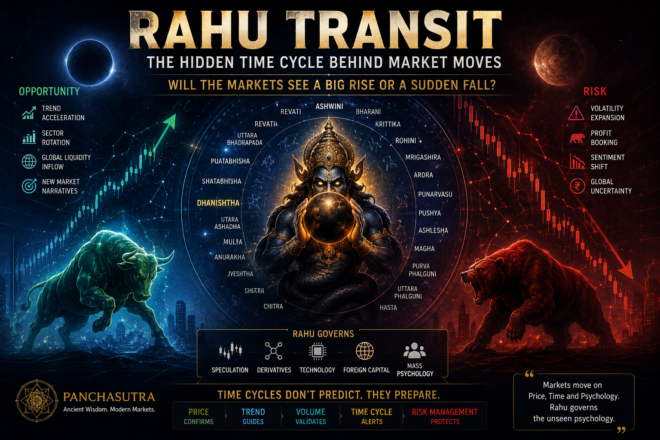
“Markets are not driven by Price alone. They are driven by Time, Liquidity and Human Psychology.”
Price tells us what is happening.
Volume tells us who is participating.
Trend tells us where the market is moving.
Time often tells us when collective psychology is most likely to change.
This is where the study of Rahu becomes fascinating.
Among all the planetary influences discussed in Vedic Astrology, Rahu occupies a unique position. Unlike the visible planets, Rahu has no physical body. It is a mathematical point—the North Lunar Node—yet for thousands of years it has been associated with desire, ambition, illusion, innovation, speculation, foreign influence, sudden change and mass psychology.
For financial markets, these themes are strikingly relevant.
Modern markets are driven by expectations rather than certainty. They thrive on leverage, technology, derivatives, algorithmic trading, artificial intelligence, media narratives and global capital flows—all areas traditionally associated with Rahu’s symbolic influence.
This does not imply that Rahu alone determines market direction. Equity markets remain influenced by corporate earnings, monetary policy, geopolitical developments, liquidity, interest rates and institutional positioning.
However, Rahu may represent an important psychological timing cycle that deserves careful observation.
At PANCHASUTRA, we do not trade astrology.
We trade Price.
But we use Time to identify periods when market behaviour, volatility and investor psychology may become more dynamic.
WHAT IS RAHU NAKSHATRA GOCHAR?
Most traders are familiar with Rahu’s movement through zodiac signs.
Very few study Rahu’s movement through Nakshatras.
This is where a deeper layer of timing begins.
A zodiac sign describes the environment in which events unfold.
A Nakshatra describes the psychological field through which those events express themselves.
In simple words,
Signs indicate the stage.
Nakshatras describe the script.
As Rahu moves retrograde from one Nakshatra to another, the collective emotional landscape gradually changes.
New market narratives emerge.
Old leadership weakens.
Speculative capital searches for fresh opportunities.
Institutional money begins rotating into different sectors.
Retail participation often becomes increasingly emotional.
These behavioural shifts rarely occur overnight, but history suggests that Nakshatra transitions frequently coincide with periods worthy of close observation.
THE 18.6-YEAR RAHU CYCLE
Astronomically, Rahu completes one revolution through all twenty-seven Nakshatras in approximately 18.6 years.
Unlike the visible planets, Rahu travels in apparent retrograde motion.
Average duration:
• Around 8–9 months in one Nakshatra
• Around 18 months in one zodiac sign
• Around 18.6 years to complete the full cycle
This creates one of the most fascinating long-term timing structures available to astro-financial researchers.
Every eighteen and a half years, Rahu revisits the same Nakshatra.
Although economic conditions differ from one cycle to another, researchers can compare recurring themes in speculation, sector leadership, liquidity expansion and investor psychology.
WHERE IS RAHU NOW?
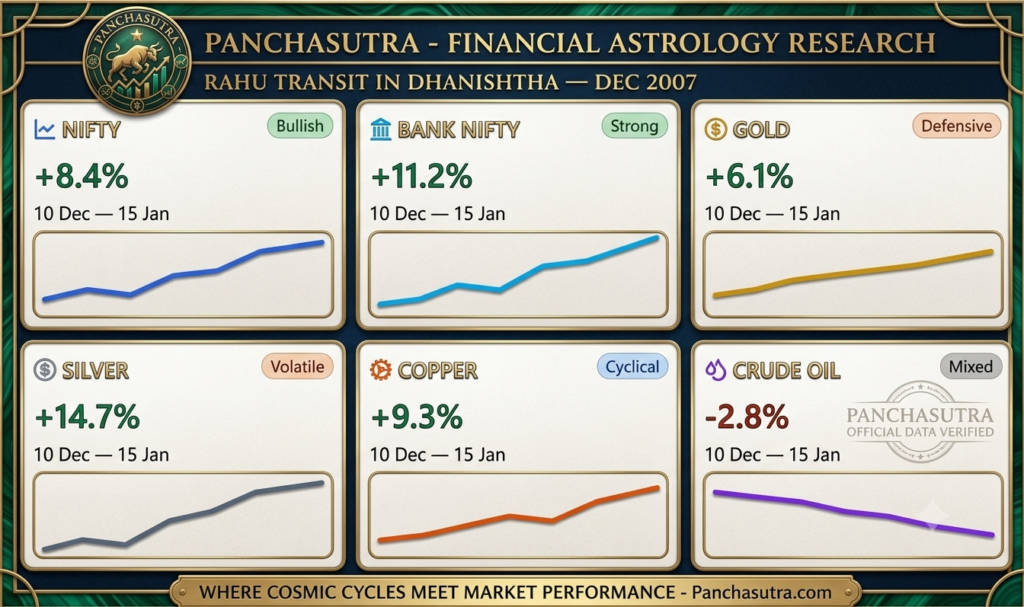
Rahu is presently transiting Dhanishtha Nakshatra, a Mars-ruled constellation traditionally associated with movement, performance, ambition, rhythm, leadership and visible achievement.
Unlike softer Nakshatras that emphasise contemplation or preservation, Dhanishtha encourages execution.
It rewards those who act.
It challenges those who hesitate.
This symbolism aligns naturally with periods when markets experience stronger participation, faster rotation between sectors, greater speculative interest and heightened competition among traders.
As Rahu continues its retrograde journey, it will eventually move into Shravana Nakshatra, marking another shift in the underlying psychological environment of the market.
Rather than viewing this as a prediction of bullishness or bearishness, PANCHASUTRA treats these transitions as Time Windows—periods during which traders should pay closer attention to changes in volatility, leadership and institutional behaviour.
WHY DHANISHTHA IS DIFFERENT
Dhanishtha is governed by Mars.
Mars represents action.
Rahu magnifies whatever it touches.
When these two archetypes combine, the result is often an environment characterised by increased ambition, urgency and a strong desire for measurable results.
Traditional astrological literature describes this transit as encouraging movement instead of stagnation.
It promotes execution rather than discussion.
It values performance over promises.
From a trading perspective, this symbolism can be translated into market behaviour.
Periods associated with Rahu in Dhanishtha may coincide with:
• Faster sector rotation
• Higher participation in derivatives
• Increased speculative positioning
• Larger intraday price swings
• Strong momentum moves
• Aggressive breakouts
• More frequent false breakouts
• Elevated options volatility
• Greater retail participation
Again, these are not trading signals.
They are behavioural tendencies that should always be confirmed through price action, volume and trend analysis.
THE PSYCHOLOGY OF RAHU IN DHANISHTHA
Ancient texts frequently describe Rahu as amplifying desire.
Dhanishtha directs that desire toward achievement.
The result is a psychological environment where investors become increasingly motivated to outperform.
Capital seeks movement.
Fund managers search for leadership sectors.
Retail traders become more active.
Financial media intensifies market narratives.
Momentum attracts additional momentum.
This can produce remarkable opportunities.
It can also create dangerous excesses.
History repeatedly reminds us that periods of intense optimism often contain the seeds of overconfidence.
Likewise, periods of extreme pessimism frequently create the foundation for the next major advance.
Understanding this balance lies at the heart of professional trading.
THE PANCHASUTRA PRINCIPLE
Rahu does not tell us whether to Buy.
Rahu does not tell us whether to Sell.
Rahu tells us when the market’s psychological environment may be changing.
Price decides the trade.
Trend confirms the direction.
Risk management protects the capital.
Time simply tells us when to pay closer attention.
That is the PANCHASUTRA approach.