




Weekly Outlook | 27 July – 31 July 2026
“Liquidity creates opportunity. Fear creates liquidity.”
The Big Picture
The coming week could become one of the most decisive weeks for the banking sector in recent months.
Bank Nifty enters the monthly expiry with an exceptionally rare convergence of technical structure, derivatives positioning, macroeconomic developments, global central bank events, and astro-financial timing cycles.
While the first trading session of the week is expected to be dominated by fear and aggressive unwinding, Panchasutra Research believes traders should remain alert to the possibility of a dramatic reversal during the monthly expiry.
Our primary theme for the week is:
The Jupiter Liquidity Squeeze
This is a week where weakness could become the fuel for strength.
Why “The Jupiter Liquidity Squeeze”?
In financial astrology, Jupiter is traditionally associated with:
- Banking
- Liquidity
- Credit Expansion
- Capital Flows
- Financial Institutions
- Wealth Creation
Whenever Jupiter-related sectors experience panic-driven corrections during supportive macro conditions, they often witness powerful liquidity-driven recoveries once selling pressure exhausts itself.
This week’s setup resembles precisely that environment.
Monday: Maximum Fear
The week is expected to begin under intense pressure.
Several important astro-financial cycles converge simultaneously.
Saturn Retrograde Station
Saturn’s retrograde station historically represents:
- tightening liquidity
- cautious institutional behaviour
- delayed risk appetite
- heavy unwinding in leveraged positions
Financial stocks generally react faster than broader indices whenever liquidity concerns emerge.
Lunar Eclipse 144° Timing Cycle
Our astro-market research has repeatedly shown that eclipse timing windows often coincide with:
- emotional trading
- exaggerated volatility
- panic selling
- false breakdowns
- sudden reversals
This timing cycle significantly increases the probability of sharp intraday swings.
Bayer Rule 20 – Mercury Geocentric Coordinates
The current Mercury coordinates continue to indicate:
- indecisive market behaviour
- increased algorithmic volatility
- frequent stop-loss hunting
- emotional positioning
Combined with Saturn’s restrictive influence, Monday may witness aggressive selling in banking counters.
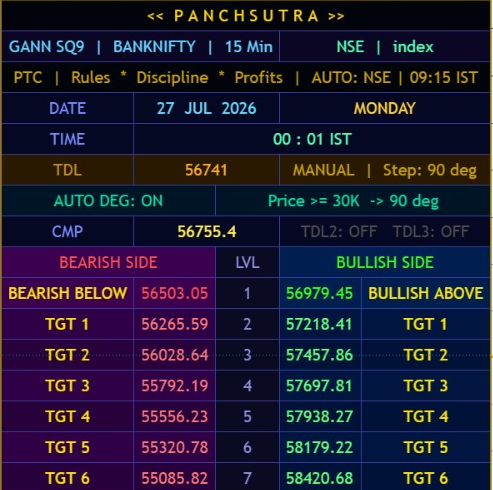
The Level That Matters
56,500
This becomes the most important level of the week.
According to the Panchasutra framework:
IF Bank Nifty successfully defends 56,500 on Monday’s closing basis,
the probability of a powerful expiry-driven recovery increases substantially.
A successful defence would indicate that institutional buyers continue accumulating despite short-term panic.
However,
a decisive close below this level would postpone the bullish recovery and increase downside risk.
Tuesday: The Liquidity Explosion
Tuesday’s Monthly Expiry has the potential to completely change market sentiment.
Why?
Because banking stocks are among the most actively traded derivative instruments.
When bearish positioning becomes excessive, expiry often forces traders to unwind short positions aggressively.
This creates:
- rapid short covering
- institutional buying
- liquidity expansion
- explosive intraday momentum
Should Monday’s support hold,
Tuesday may witness one of the strongest short-covering rallies of the month.
Mercury Turns Direct – A Positive Shift for Financial Stocks
One of the most significant astro-financial developments is that Mercury has transitioned from Retrograde to Direct motion.
Historically, Panchasutra Research has observed that Mercury Direct frequently marks the end of prolonged indecision and the beginning of more sustained directional price movement.
During Mercury Retrograde, markets often experience:
- false breakouts
- repeated whipsaws
- sideways movement
- indecisive trading
After Mercury turns Direct, markets have historically shown:
- improved trend quality
- stronger follow-through
- higher probability of directional moves
- better momentum participation
For Bank Nifty, this transition is particularly important because banking stocks respond quickly when market conviction returns.
While Mercury Direct does not guarantee bullishness, it increases the probability that the market will choose a clearer direction rather than remain trapped in a volatile range.
Falling Crude – A Tailwind for Banking
One of the biggest macro positives this week remains the decline in crude oil prices.
Lower crude prices can support the banking sector by:
- reducing inflationary pressures
- improving the interest-rate outlook
- lowering funding concerns
- supporting credit growth
- improving corporate profitability
A benign inflation outlook often strengthens expectations that monetary conditions can remain supportive for financial institutions.
This creates a favourable backdrop for banking stocks once panic selling subsides.
Why Bank Nifty Could Outperform Nifty
Historically, during liquidity-driven recoveries, Bank Nifty often leads the broader market.
Reasons include:
- highest institutional participation
- largest derivative exposure
- significant FII positioning
- rapid sector rotation
- higher beta during recovery phases
If the expected short squeeze materializes, Bank Nifty could outperform the broader indices.
Watch the 24 July Candle
Just like Nifty, the 24 July 2026 High and Low will serve as a critical reference range for Bank Nifty.
Above the 24 July High
A decisive breakout above this level would signal that buyers have regained control, confirming the possibility of a sustained upside move.
Below the 24 July Low
A breakdown below this level would indicate renewed weakness and increase the probability of further liquidation.
This range should be treated as the market’s immediate directional trigger.
Global Events That Could Drive Bank Nifty
The coming week is packed with global events that can significantly influence banking stocks and overall market liquidity.
Key events include:
- US Federal Reserve Policy Meeting – Any change in the Fed’s tone on interest rates could influence global liquidity and foreign investment flows.
- US Q2 GDP Data – A key indicator of economic strength that could affect global risk appetite.
- US Core PCE Inflation – The Fed’s preferred inflation gauge, closely watched by global financial markets.
- Bank of Japan Policy Decision – Any adjustment to monetary policy may impact global bond yields and capital flows.
- China Manufacturing PMI – A leading indicator of economic activity in Asia.
- Major Global Earnings – Results from major technology companies such as Microsoft, Apple, Amazon, and Meta can shape global market sentiment.
- Crude Oil & Middle East Developments – Continued easing in geopolitical tensions and stable oil prices would remain supportive for financial markets.
These events are likely to create periods of elevated volatility, especially in banking and financial stocks.
Derivative Perspective
Monthly expiry weeks often produce dramatic shifts in positioning.
Watch closely for:
- Open Interest unwinding
- Short-covering build-up
- Put Writing near support
- Call unwinding above resistance
- FII index futures positioning
- Banking heavyweight participation
A sharp increase in long unwinding early in the week followed by aggressive short covering would strongly support the Jupiter Liquidity Squeeze thesis.
Panchasutra Trading Roadmap
Scenario 1 – Preferred View
- Panic Gap Down on Monday
- Test of 56,500 Support
- Successful Closing Defence
- Tuesday Expiry Short Covering
- Strong Recovery Led by Banking Stocks
- Bank Nifty Outperforms Nifty
Scenario 2 – Alternate View
- Breakdown Below 56,500
- Close Below 24 July Low
- Fresh Liquidation
- Expiry Recovery Delayed
- Defensive Trading Environment
What Traders Should Watch
This week, avoid reacting emotionally to the opening session.
Instead, monitor:
- Price behaviour around 56,500
- The High and Low of 24 July
- Banking heavyweight participation (HDFC Bank, ICICI Bank, SBI, Axis Bank, Kotak Mahindra Bank)
- Open Interest shifts during expiry
- Crude oil movement
- Global central bank commentary
- FII and DII activity
- Whether Bank Nifty reclaims key short-term moving averages after Monday’s session
The combination of these factors will reveal whether the expected liquidity squeeze is unfolding.
Final Thoughts
The coming expiry week presents a classic environment where panic and opportunity may coexist.
Bank Nifty sits at the intersection of technical support, derivatives positioning, macroeconomic developments, and astro-financial timing cycles. While Monday may begin with intense selling pressure driven by Saturn’s Retrograde Station, the Lunar Eclipse timing window, and lingering uncertainty, the broader backdrop is becoming increasingly constructive.
Mercury turning Direct historically signals a shift from confusion toward clearer market direction. At the same time, softer crude prices and expectations around global monetary policy could improve sentiment toward financial stocks. If Bank Nifty successfully defends 56,500 and absorbs the early selling pressure, the stage could be set for a powerful expiry-driven short-covering rally.
At Panchasutra Trading Research, our focus this week remains on three decisive questions:
- Can Bank Nifty defend the critical 56,500 support on a closing basis?
- Will the index reclaim the 24 July High and confirm a fresh directional move?
- Will Mercury Direct and improving liquidity conditions trigger the “Jupiter Liquidity Squeeze” that propels banking stocks higher?
The answers to these questions may not only determine the outcome of the monthly expiry but could also define the leadership of the banking sector in the weeks ahead.
Panchasutra Trading Research
“When liquidity contracts, fear dominates. When liquidity returns, trends are born. Time reveals the transition before price confirms it.”
Disclaimer: This report is intended solely for educational and research purposes. It reflects the Panchasutra methodology, which integrates technical analysis, derivatives, macroeconomics, and astro-financial timing. It should not be interpreted as investment advice or a recommendation to buy or sell securities. Traders should apply prudent risk management and consult a qualified financial advisor before making investment decisions.