



The Hidden Force Behind Today’s Market Selloff
For most retail traders, today’s market looked confusing.
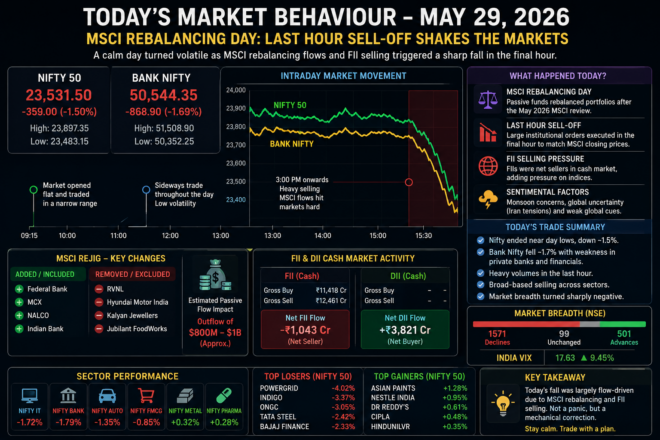
Nifty and Bank Nifty traded relatively stable for most of the session. But suddenly, during the final hour, massive selling emerged and benchmark indices collapsed sharply.
- Sensex plunged more than 1000 points
- Nifty slipped below 23,550
- Bank Nifty witnessed aggressive profit booking
- Heavyweights saw sharp algorithmic selling near closing bell
Many traders assumed this was panic selling.
But the reality was different.
Today’s sharp move was largely influenced by MSCI Rebalancing, one of the most powerful yet least understood events in global financial markets.
What is MSCI?
MSCI (Morgan Stanley Capital International) is a global index provider.
It creates benchmark indices that are tracked by:
- Global ETFs
- Sovereign funds
- Pension funds
- Passive institutional investors
- Foreign portfolio investors (FPIs)
Thousands of billions of dollars worldwide follow MSCI indices.
For example:
- MSCI Emerging Markets Index
- MSCI India Index
- MSCI World Index
Whenever MSCI changes the weightage or composition of stocks, global funds are forced to buy or sell accordingly.
This process is called:
MSCI Rebalancing
How Does MSCI Rebalancing Work?
MSCI periodically reviews:
- Market capitalization
- Liquidity
- Free float
- Trading activity
- Sector representation
Based on these factors:
- Some stocks are added
- Some stocks are removed
- Some stocks receive higher or lower weightage
After announcement, passive funds tracking MSCI must rebalance their portfolios exactly according to new allocations.
This creates enormous institutional buying and selling pressure.
Why Was Today Important?
Today’s session marked the effective implementation of the May 2026 MSCI review.
Several Indian stocks witnessed:
- Inclusion upgrades
- Weight adjustments
- Exclusions from MSCI baskets
Because of this:
- Global funds executed massive orders near market close
- Algorithms became extremely active
- Closing volatility exploded
Stocks in Focus During MSCI Rejig
Some notable inclusions reportedly included:
- MCX
- Federal Bank
- NALCO
- Indian Bank
Some important exclusions/reductions included:
- RVNL
- Kalyan Jewellers
- SBI Card
- Hyundai Motor India
These changes triggered forced institutional flows across multiple sectors.
Why Selling Happens Near Closing Bell
Most global funds execute MSCI-related trades during the final minutes of trading.
Why?
Because MSCI calculations are based on official closing prices.
So institutions try to match:
- Closing auction prices
- Final settlement values
- Index benchmark levels
That is why markets often experience:
- Sudden spikes
- Large candles
- Massive volumes
- Sharp reversals
- Violent last-hour moves
Today was a classic example.
Today’s Nifty & Bank Nifty Trade Summary
Nifty
Nifty remained range-bound during the first half but weakness intensified in the final session.
Key observations:
- Heavy selling emerged after 3 PM
- FIIs remained net sellers in cash market
- Index heavyweights dragged benchmarks lower
- Closing sentiment turned decisively bearish
Nifty closed near day lows after losing around 359 points.
The sharp fall indicates:
- Institutional distribution
- Weak closing breadth
- High algorithmic participation
- Pressure from passive fund execution
Bank Nifty
Bank Nifty initially attempted stability but failed to absorb broader market weakness.
Private banks and heavyweight financials witnessed:
- Profit booking
- Derivative unwinding
- Late-session institutional selling
Since financials carry massive index weightage in MSCI and benchmark indices, Bank Nifty became highly sensitive to passive flows.
The closing structure suggests:
- Momentum slowdown
- Volatility expansion
- Increased uncertainty for short-term traders
Was This a Genuine Market Crash?
Not entirely.
Today’s move was more:
- Mechanical
- Flow-driven
- Index-related
rather than pure fear-based panic.
However, additional negative factors worsened sentiment:
- Weak monsoon concerns
- Rising geopolitical uncertainty around Iran
- Persistent FII cash selling
- Global risk-off sentiment
All these factors amplified the MSCI effect.
Important Lesson for Traders
MSCI days are different from normal trading sessions.
Price action becomes:
- Highly distorted
- Liquidity-driven
- Algorithm-heavy
- Less technically reliable
During such sessions:
- Option premiums can behave abnormally
- Intraday reversals become violent
- Stop losses trigger rapidly
- Closing candles can mislead retail traders
Understanding institutional flow dynamics is extremely important for serious traders.
Final Thoughts
Today’s market fall was not caused by a single breaking-news event.
It was a combination of:
- MSCI rebalancing execution
- FII selling pressure
- Weak global sentiment
- Monsoon and geopolitical concerns
For experienced traders, such sessions are reminders that markets are not moved only by charts and indicators — but also by global institutional money flows operating behind the scenes.
And today, that invisible force became clearly visible on Dalal Street.