


Why Most Traders Fail Despite Learning Technical Analysis
Every trader starts with excitement.
Some dream of financial freedom.
Some want independence.
Some believe trading is the fastest route to wealth.
But after a few months, many traders face the same painful reality:
- Emotional losses
- Capital destruction
- Overtrading
- Fear and confusion
Slowly they realize:
“The market is not difficult because of charts.
The market is difficult because of human emotions.”
Most traders spend years searching for:
- Secret indicators
- Magic strategies
- Perfect entry systems
But the real breakthrough in trading comes from mastering what we call:
The Panchasutra of Trading
The five timeless principles that separate disciplined traders from emotional traders.
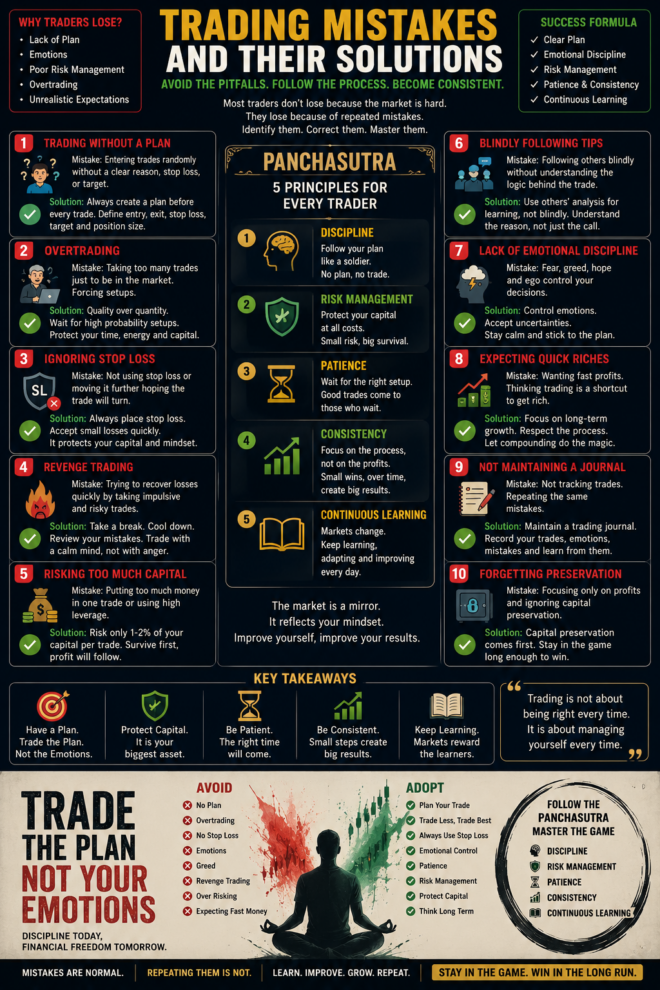
These five principles are:
- Discipline
- Risk Management
- Patience
- Consistency
- Continuous Learning
Every trading mistake ultimately violates one of these Panchasutras.
Let us understand how.
1. Trading Without a Plan
Violation of the First Panchasutra — Discipline
The Mistake
Many traders enter positions:
- Randomly
- Emotionally
- Based on tips
- Because of FOMO
- Without stop loss or target
This transforms trading into gambling.
The Solution
Discipline means:
“Trade the system, not the emotion.”
Before every trade, ask:
- Why am I entering?
- Where is my stop loss?
- What is my target?
- How much am I risking?
A disciplined trader follows rules even when emotions disagree.
Because:
No plan = No trade.
2. Overtrading
Violation of the Third Panchasutra — Patience
The Mistake
Many traders think:
“More trades will create more profits.”
So they:
- Trade every candle
- Force setups
- Stay glued to charts all day
Eventually:
- Mental fatigue rises
- Accuracy drops
- Emotions dominate
The Solution
Patience is one of the rarest trading skills.
Professional traders understand:
Markets reward waiting.
The best setups often come to traders who:
- Observe calmly
- Wait for confirmation
- Respect timing
Sometimes the best trade is:
No trade.
3. Ignoring Stop Loss
Violation of the Second Panchasutra — Risk Management
The Mistake
Retail traders often:
- Remove stop losses
- Average losing trades
- Hope the market reverses
Small losses then become disasters.
The Solution
Risk management is survival.
A trader who protects capital can always return tomorrow.
But a trader who destroys capital loses:
- Confidence
- Stability
- Decision-making ability
Professional traders accept small losses quickly because they understand:
Preservation comes before profit.
4. Revenge Trading
Violation of Discipline and Patience
The Mistake
After a loss, emotions explode.
The trader wants immediate recovery.
This leads to:
- Aggressive entries
- Bigger quantities
- Emotional decision making
And usually:
- Bigger losses
The Solution
Trading emotionally is like driving fast in fog.
After a major loss:
- Reduce position size
- Take a break
- Calm the mind
- Review mistakes objectively
The market does not reward anger.
It rewards clarity.
5. Risking Too Much Capital
Violation of Risk Management
The Mistake
Many traders use:
- Excess leverage
- Full-margin trades
- Huge option quantities
One bad session destroys months of hard work.
The Solution
Successful trading is not about making the maximum profit in one trade.
It is about surviving long enough to compound consistently.
The second Panchasutra teaches:
Protect capital at all costs.
Because:
Small risk creates emotional stability.
Emotional stability creates better decisions.
6. Blindly Following Tips
Violation of Continuous Learning
The Mistake
Many traders blindly follow:
- Telegram calls
- Social media influencers
- “Guaranteed” market tips
Without understanding:
- Market structure
- Risk
- Logic behind the trade
The Solution
Learning is a lifelong process.
A trader must continuously improve:
- Knowledge
- Observation
- Understanding
- Market awareness
Use others’ analysis for education — not dependency.
Because:
Dependency creates weakness.
Learning creates confidence.
7. Lack of Emotional Control
The Core Enemy of Every Trader
The Mistake
The market constantly tests:
- Fear
- Greed
- Ego
- Hope
- Impatience
Many traders lose not because their analysis is wrong —
but because emotions interfere with execution.
The Solution
The Panchasutra begins with self-mastery.
A calm trader:
- Thinks clearly
- Executes better
- Handles losses professionally
Trading psychology is not motivation.
It is practical survival science.
8. Expecting Quick Riches
Violation of Consistency
The Mistake
Social media has created dangerous illusions.
Many traders believe:
- Trading is easy money
- Daily profits are guaranteed
- Small capital will become crores overnight
This mindset creates:
- Gambling behavior
- Emotional instability
- Overleveraging
The Solution
The fourth Panchasutra teaches:
Consistency Over Excitement
Wealth in trading is usually built slowly through:
- Discipline
- Repetition
- Process
- Compounding
Small consistent progress is more powerful than temporary lucky profits.
9. Not Maintaining a Trading Journal
Violation of Continuous Learning
The Mistake
Most traders never study themselves.
So they repeat:
- Emotional mistakes
- Entry mistakes
- Risk mistakes
again and again.
The Solution
Maintain a trading journal:
- Entry reason
- Exit reason
- Emotional condition
- Mistakes
- Lessons
The market teaches daily lessons.
But only serious traders record them.
10. Forgetting the Real Goal of Trading
The Mistake
Many traders focus only on:
- Money
- Profit screenshots
- Fast success
But ignore:
- Mental stability
- Process
- Survival
- Skill development
The Solution
The true purpose of trading is not instant riches.
It is:
- Financial growth
- Mental discipline
- Strategic thinking
- Long-term consistency
The market rewards traders who remain stable during chaos.
The Panchasutra of Trading
1. Discipline
Trade the plan, not emotions.
2. Risk Management
Protect capital before chasing profits.
3. Patience
Wait for quality opportunities.
4. Consistency
Small disciplined actions create long-term success.
5. Continuous Learning
Markets evolve. Traders must evolve too.
Final Thoughts
The market is a mirror.
It reflects:
- Your discipline
- Your patience
- Your emotional stability
- Your risk management
Most traders search for the perfect indicator.
But successful traders eventually realize:
The real edge is not the indicator.
The real edge is self-control.
Trading mastery begins when:
- Ego becomes smaller
- Discipline becomes stronger
- Emotions become calmer
- Risk becomes controlled
Because in the end:
Trading is not about predicting every move correctly.
It is about managing yourself correctly while the market behaves unpredictably.
And that is the true essence of the Panchasutra of Trading.