




For those of us tracking the markets, the last few sessions have felt like watching a high-stakes chess match. As we wrap up July 2026, the Bank Nifty has turned into a fascinating study of restraint, oscillating within a tight consolidation zone that has traders and analysts leaning in to see who blinks first.
At Panchasutra, we believe in cutting through the noise. Here’s the pulse of the banking index as it stands today.
The Current Landscape: A Battle of Ranges
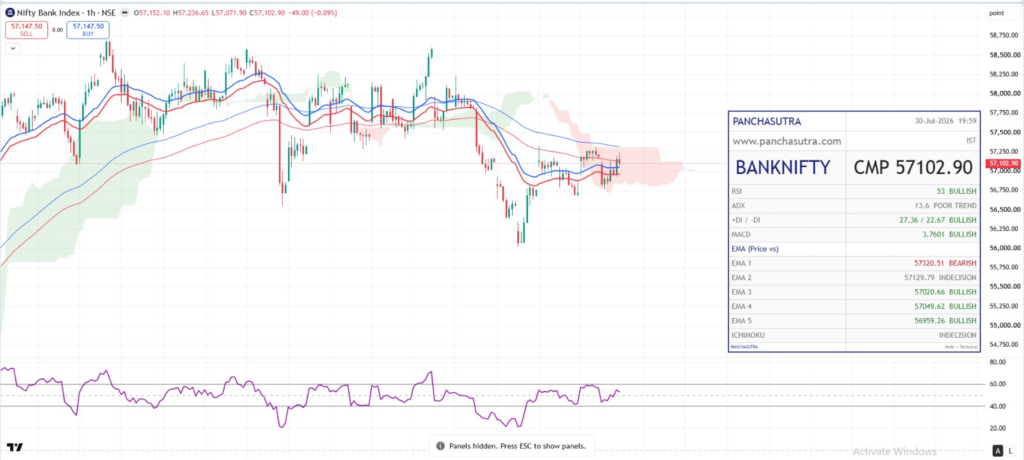
Bank Nifty closed recently near the 57,150 mark, effectively trapped in a consolidation range between 56,800 and 57,500. If you look at the technical setup, it’s clear: the index is currently underperforming the broader Nifty 50, which has been showing a bit more resilience.
The sentiment? It’s hovering between “cautiously bullish” and “wait-and-see”. The index is currently struggling to maintain a decisive move above the 57,500 resistance level—a hurdle that has defined the last few days of trade.
The Critical Pivot Points
For the active trader, the levels are non-negotiable right now:
- The Upside Trigger: We need to see a clean, sustained close above 57,500. That’s the key to reviving bullish momentum and targeting the 58,000 zone.
- The Support Floor: On the flip side, keep a close watch on 56,800. If this breaks, the index has a natural gravitation toward 56,400, where short-term moving averages are likely to act as a safety net.
What’s Driving the Narrative?
We’ve been seeing a mix of high-frequency data and corporate earnings that are keeping the BFSI space on its toes. Earnings, specifically those in the broader financial services sector, are being scrutinized for clues on asset quality and margin trends.
The “low-fear” environment—with the India VIX holding relatively steady—suggests that market participants aren’t hitting the panic button yet. However, the divergence between foreign institutional investor (FII) flows and domestic moves remains a critical factor to watch as we head into August.
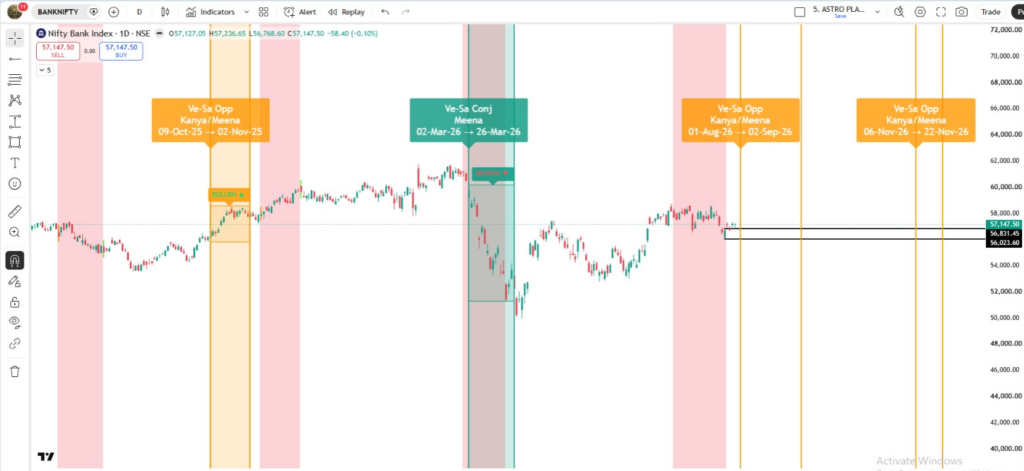
The Cosmic Confluence: Timing the Market Beyond the Charts
While we obsess over candles and volumes, seasoned market observers often keep one eye on the planetary cycles that have historically mirrored shifts in investor psychology. We’ve just navigated a significant transition: Mercury turned direct on July 24, 2026. In the world of financial astrology, this shift is more than just a calendar date—it traditionally marks the lifting of the “retrograde fog,” where communication breakdowns, technical glitches, and decision-making indecision begin to clear. For the banking sector, this often signals a return to smoother transactional flow and a stabilization in the momentum that may have felt stalled over the past few weeks.
Looking ahead, we are approaching a tension point as Venus and Saturn engage in their respective alignments. Saturn, the great “tester” of the zodiac, represents discipline, reality, and the inevitable correction of excess. When Venus—the planet of value and liquidity—interacts with Saturn’s restrictive influence, the market often undergoes a “reality check”.
For the Panchasutra investor, this is a signal to remain grounded. These cycles rarely dictate a crash, but they do demand a higher standard of proof for current valuations. As we watch the Bank Nifty navigate these days, treat these celestial events as a reminder: when the stars suggest caution, it’s usually the best time to prioritize risk management over aggressive speculation. Stay disciplined—the market is currently asking the hard questions, and the best answers are always found in a robust, well-hedged portfolio.
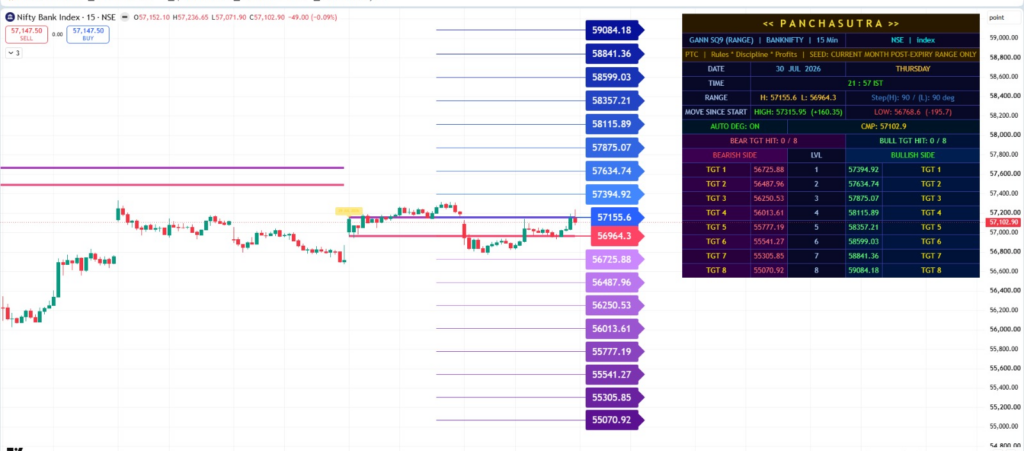
Decoding the Post-Expiry Pulse: A Gann Perspective
In the world of derivatives, the monthly expiry is more than just a settlement date—it is the market’s “reset button.” As we move into the post-expiry phase, the volatility that defined the end of July is beginning to give way to a new structural formation. At Panchasutra, we look at this transition through the lens of the Gann Square of 9, a tool that treats price not just as a number, but as a point in a geometric cycle.
Understanding the Range
The “post-expiry range” acts as our new foundation. Following the July 2026 expiry, the Bank Nifty has established a critical zone around the 57,150 level. Traders often look at the high and low established immediately following the expiry—these levels serve as the “walls” of the new price box. When the market breaks out of this box, it typically signals the start of a new, sustained trend.
Gann Square of 9: Critical Levels
Using the current index reference of 57,150 as our starting point, the Square of 9 helps us identify the “geometric support and resistance” that market participants often ignore:
The Panchasutra Insight
The beauty of the post-expiry range is that it strips away the noise of expiring contracts. By mapping these onto the Gann wheel, we aren’t just guessing support and resistance; we are identifying the levels where the “market geometry” is most likely to encounter friction.
If the Bank Nifty respects the 56,785 support while consolidating, the path of least resistance remains upward toward the 57,515 Gann alignment. However, watch for a failure to hold these levels—in Gann theory, once a major support line is broken, the index often accelerates toward the next “square” down.
The Bottom Line: Treat the post-expiry range as your map and the Gann levels as your compass. In a market recovering from the gravitational pull of expiry, the most profitable moves often occur when price tests these calculated geometric levels and finds new, institutional interest. Stay tactical, keep your stops disciplined, and let the geometry guide your entry.
Disclaimer: This analysis is for educational purposes and based on technical indicators (Gann theory). Market participation involves significant risk; ensure you consult a qualified financial advisor before deploying capital. We always wish you all best of health and wealth.
ALL ABOVE ANALYSIS IS GENERATED USING OUR PANCHASUTRA INDICATORS AVAILABLE IN PANEL ABOVE THIS ARTICLE IN OUR INDICATOR TAB.